

Most sceptics date the Shroud of Turin to the 1350s when it was first recorded as being kept by the prestigious French knight Geoffroi de Charny in the collegiate church he’d had built for it in Lirey. Before the carbon dating was even done, Walter McCrone predicted that this would be the carbon date result purely because the provenance started here.
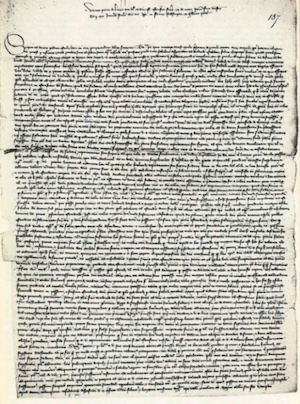
One of the evidences most frequently used to show that this date is correct are the two draft copies of a letter penned by Bishop D’Arcis stating that in 1355, Bishop Henri of Troyes wrote that he had actually discovered the artist who painted the image (no evidence that this letter was sent has been found). These draft letters were discovered by Catholic canon and conservative historian Ulysse Chevalier in 1900 and by presented by Jesuit scholar Father Herbert Thurston in his article ‘The Turin Shroud and the verdict of history’. Chevalier found the document—which lacked a signature and a precise date—in the Collection de Champagne within the Bibliothèque Nationale in Paris. He assigned it the speculative date of ‘end of 1389’ to align it chronologically with the subsequent papal responses from Avignon Pope Clement VII in early 1390.
The sudden burst of research by both Ulysse Chevalier and Father Herbert Thurston was a direct, adversarial reaction to the photographic breakthrough of Secondo Pia and the scientific defence mounted by Paul Vignon. (For a comprehensive view read The Medieval Hypothesis of the Shroud of Turin by Jack Markwardt). Prior to May 1898, the Shroud of Turin was largely regarded as a quiet, pious relic, seldom displayed and rarely analysed. Everything changed overnight when Secondo Pia took the very first photograph of the Shroud. When he developed the glass plate in his darkroom, he discovered that the faint, confusing stains on the linen were actually a photographic negative—revealing a strikingly realistic, anatomically precise positive image of a crucified man.
A global sensation
Pia’s photographs caused a global sensation. In Paris, the brilliant Catholic biologist Paul Vignon(along with his agnostic colleague Professor Yves Delage) began a rigorous scientific investigation of the images. Vignon formulated his “vaporigraph” theory, arguing that the image was naturally produced by ammoniacal chemical vapours interacting with a cloth soaked in oil and aloes— meaning it was a perfect chemical negative that no medieval painter could have conceived, let alone executed.
This new ‘scientific proof’ of the Shroud’s authenticity deeply alarmed critical historians and progressive church scholars, who feared that the Catholic Church would be swept into endorsing a pseudoscientific myth. It was precisely this pro-authenticity movement, led by Vignon’s early presentations and publications (which culminated in his landmark 1902 book Le Saint Suaire de Turin), that forced the sceptics into action.
Chevalier, a meticulous medieval historian and Catholic priest, was horrified by the sudden wave of ‘Shroud-mania’ triggered by Pia’s photograph. He believed faith should not be built on historical fabrications. In direct response to the craze of 1898–1899, he dove into the French archives to unearth hard, contemporary evidence to debunk the “scientific” claims. His discovery and rapid publication of the D’Arcis memorandum in 1900was intended to be the ultimate historical antidote to Pia’s camera. Both Pia and Delage suffered detrimentally because of Chevalier’s work.
Henri de Poitiers
So what actually happened at Lirey and was the document genuine and the artist really found? The Act of Foundation for Charny’s church at Lirey was first started in June 1353 and was completed in June 1356 just three months before he was killed at the Battle of Poitiers. Bishop Henri de Poitiers wrote regarding the Lirey church in 1356 the month before the Act of Foundation was completed. What, exactly, is stated in Bishop Henri de Poitiers’ letter of May 28, 1356 about the church at Lirey? This is what the bishop said in that letter:
“You will learn what we ourselves learned on seeing, hearing, and scrupulously examining the letters of the noble knight Geoffroi de Charny, Lord of Savoy and of Lirey, to and for whom our present letters are enclosed, especially of the said knight’s sentiments of devotion, which he has hitherto manifested for the divine cult and which he manifests ever more daily. And ourselves wishing to develop as much as possible a cult of this nature, we praise, ratify and approve the said letters in all their parts—a cult which is declared and reported to have been canonically and ritually prescribed, as we have been informed by legitimate documents. To all these, we give our assent, our authority and our decision, by faith of which we esteem it our duty to affix our seal to this present letter in perpetual memory.”
Indeed, the only documentation even mentioned in this letter is the vague and unidentified ‘legitimate documents’ which approved a divine cult to which Geoffroi had been manifestly devoted. Jack Markwardt suggests that this is a reference to the Pope’s approval of the Shroud’s exhibition for veneration at Lirey.
This is the same Bishop Henri cited in the D’Arcis memorandum as having discovered an artist. There is no other record of this alleged artist in existence. (The possibility has been proposed by others e.g. Robert Rucker, that a copy might have been made of the Shroud image by an artist as was similarly made by other artists to copy the image, for instance like the copy of the image of Besancon.)
How the Shroud came to be in Lirey
It’s possible that the Shroud was in the possession of Geoffroi de Charny as early as 1317 through the Templar connection. The Charny family connection to the Templars did exist. The Charny family provided financial support to the Knights Templar and recruited their sons into the Order, suggesting a close family tie between the Templar and the later Geoffroi de Charny. Historian Ian Wilson believes it is likely that it is through this family connection that the Shroud eventually came to Lirey.
On the other hand historian Jack Markwardt believes that the Shroud came into his possession via a different route. Markwardt argues that the Shroud came into the possession of a Jean de Joinville who was the maternal grandfather of Geoffroi de Charny and that it was gifted to him by Louis IX king of France (who was a close friend) who received the Shroud from Baldwin of Constantinople after Louis had paid the ransom for his young son Philip, to avoid any accusations of Simony.
Markwardt asserts that Shroud would have been kept in secrecy until the time when de Charny established the collegiate church at Lirey to house his relic and that he intentionally kept the description of the Shroud vague and did not declare its true identity to the wider public until its display.
We do know that the Shroud was not mentioned in the Act of Foundation. How De Charny acquired the Shroud remains somewhat of a mystery and there are various hypotheses. His granddaughter Marguerite de Charny provided very vague and conflicting explanations when her ownership was questioned in the 1450’s.
According to historical records and court disputes from that era, she primarily claimed that the Shroud was acquired by her grandfather, Geoffroi de Charny, as spoils of war(or a conquest of war). At other times, her family descriptions vaguely referred to it as a ‘reward freely given’ for his military service and bravery.
Pilgrim Medalions
Bishop D’Arcis of Troyes was a later successor to Henri and his draft letter is dated (by Chevalier) to 1389, the date thought to be concurrent with the display of the Shroud in Lirey by Geoffroi de Charny II (the son). Pilgrim medals have been found for these displays, interestingly with the coats of arms reversed. The more basic Machy badge giving prominence to Jeanne, the wife of Geoffroi, over his coat of arms and vice versa on the Paris badge. Ian Wilson believes this is because the Shroud was not shown in Lirey until after his death by his wife.
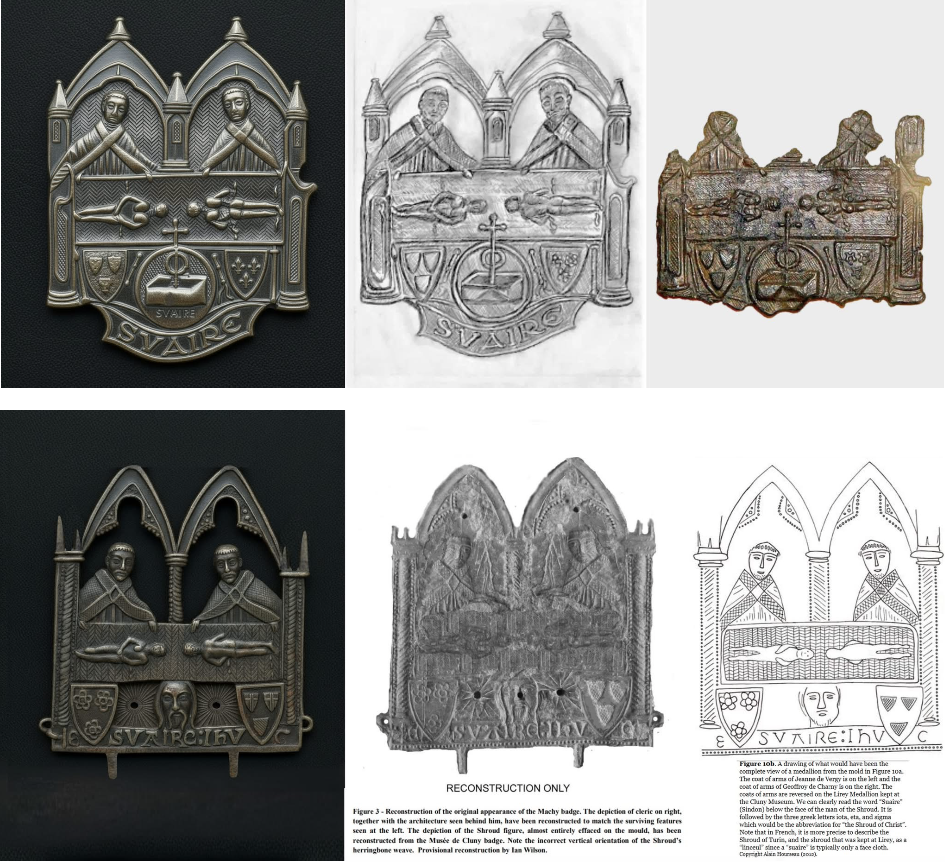
Top: Paris Pilgrim Badge and reconstruction
Bottom: Machy Pilgrim Badge and reconstruction
(Images produced by Otangelo Grasso)
The later prominence of the de Charny coat of arms is because his son began to show the Shroud (hence the annoyance of D’Arcis). However, Jack Markwardt believes the Shroud was first shown by Geoffroi prior to his death:
“It has always surprised me that Wilson has extended credibility to Bishop d’Arcis’ hearsay and unsubstantiated claims, including his allegation that Bishop Henri de Poitiers tried to suppress the 1350s exhibitions. This claim is refuted by historical evidence, including a later papal curia bull supportive of the church of Lirey.
In any event, I believe it was erroneous to state, as an uncontested fact, that the 1350s Shroud exhibitions began after Geoffrey’s death and that they were sponsored by his very young widow, impliedly without her having first obtained the required papal approval”
“Other than the hearsay and unsubstantiated allegations of Bishop d’Arcis, dating to some 34 years after the exhibitions were held, there is zero evidence that these showings were ever contentious and/or were condemned by any ecclesiastical authority”.
Financial motives for the D’Arcis letter
Could there have been a reason why D’Arcis wrote these drafts which may never have been sent? It is known that during the exact period d’Arcis was trying to shut down the Shroud expositions at Lirey, his own diocese was facing a perfect storm of structural disasters and economic ruin. Building and maintaining a massive Gothic cathedral required staggering amounts of money, and the Cathedral of Saint-Pierre-et-Saint-Paul in Troyes kept getting battered by disasters. A tornado in 1365 severely damaged the 110 metre spire, a fire in 1389 burned down the roof of the nave and in 1390 the massive Rose window collapsed which took nearly two decades to fix. Because of these persistent financial drains and funding shortages, the cathedral was never actually finished—its planned south tower (the Saint-Paul tower) was abandoned completely due to a lack of money.
Whilst the Pope had previously told the Deans of Lirey that they could exhibit the Shroud as a ‘representation’, Pope Clement VII didn’t just tell d’Arcis to drop the matter—he issued a formal papal threat that put the bishop’s entire career and spiritual standing on the line. When the dispute between the de Charny family and Bishop d’Arcis boiled over regarding the expositions at Lirey, Clement VII issued a series of papal bulls and letters dating from late 1389 into January 1390. He officially commanded Pierre d’Arcis to cease his crusade against the Shroud exhibitions. In the legal language of the medieval church, he imposed perpetual silenceon the bishop. D’Arcis was strictly forbidden from speaking out against the cloth, disrupting the pilgrims, or trying to interfere with the de Charny family’s displays.
To ensure D’Arcis complied, the Pope attached the ultimate ecclesiastical penalty to his command. If D’Arcis continued to preach against the Shroud or tried to shut down the Lirey exhibitions, he faced automatic excommunication. For a medieval bishop, being cut off from the Church would mean losing his office, his authority, and his spiritual standing. By threatening D’Arcis with excommunication, Clement VII successfully buried the bishop’s formal protest and ensured the Shroud could continue to be shown, leaving D’Arcis powerless to stop it.
Other critics from this period
To be fair D’Arcis was not the only one who condemned the Shroud (along with the super abundance of relics) during that period. The 14th-century French philosopher, theologian, and mathematician Nicole Oresme(who later became the Bishop of Lisieux) denounced the Shroud as a clear, “patent” example of clerical deception and forgery. His writings on the cloth represent the earliest known written rejection of the Shroud’s authenticity, predating Bishop Pierre D’Arcis famous 1389 memorandum by nearly two decades.
His specific critique of the Shroud is preserved in his treatise Problemata (composed between 1370 and his death in 1382). In a section analysing mirabilia (unexplained or seemingly wondrous phenomena), Oresme applied a highly sceptical, rational approach to the relic at Lirey. Historian Nicolas Sarzeaud recovered the exact passage, in which Oresme writes:
“I do not need to believe anyone who claims: ‘Someone performed such miracle for me’, because many clergymen thus deceive others, in order to elicit offerings for their churches. This is clearly the case for a church in Champagne, where it was said that there was the shroud of the Lord Jesus Christ, and for the almost infinite number of those who have forged such things, and others.”
Whilst it is likely that his denunciation was a general and heartfelt comment on the Christian religion in France at that time, he obviously hated the thought that people’s fears were being exploited.
A dark period in the history of France
By 1350, France was in an absolutely catastrophic state. It was arguably one of the darkest periods in the nation’s history, reeling from a triple blow of military humiliation, political instability, and demographic collapse.
The Black Plague had struck France fiercely between 1348 and 1349, and by 1350, the country was just beginning to emerge from the worst of the initial outbreak. The plague wiped out roughly one-third to one-half of the French population. Entire villages were abandoned, fields lay fallow due to a severe shortage of agricultural labour, and the economy was in a state of paralysis.
France was suffering deeply from the opening campaigns of the 100 Years War. A few years prior, the English longbowmen had decimated the flower of French chivalry at the Battle of Crécy (1346). Following that disaster, King Edward III of England captured the vital port city of Calais in 1347, giving the English a permanent, fortified beachhead right on the edge of northern France.
In August 1350, King Philip VI—the first Valois monarch, whose legitimacy the English contested —died. He left behind a fractured, bankrupt kingdom to his son, John II (known to history as John the Good). John II inherited a mess. The royal treasury was completely empty because of wartime expenses and a collapsed tax base. To make matters worse, John faced bitter domestic opposition from his own cousin, Charles the Bad of Navarre, who held extensive lands in Normandy and actively conspired with the English to undermine the French crown.
With the central government broke and weak, large swathes of the French countryside fell into lawlessness. Out-of-work mercenary soldiers formed Free Companies(Grandes Compagnies). These brigands roamed the provinces, pillaging towns, extorting the peasantry, and burning crops, which added a layer of human-made terror to the misery already left behind by the plague. In short, by 1350, France was depopulated, financially ruined, politically unstable, and vulnerable to the next wave of English invasions, which would culminate a few years later in another massive disaster at Poitiers in 1356 where Geoffroi de Charny, the knight who carried the Oriflamme, was killed.
So it’s easy to see why in the period relating to the Shroud that a culture of fear and doubt ruled the country and why people like Oresme were so keen to protect the people from false hope and deception.
Reasons to doubt the d’Arcis Memorandum claims
Not much about the provenance is clear cut, with the mystery surrounding its ownership by Geoffroi de Charny, how he acquired it, who showed it and when. When Henri of Troyes referred to the cult at Lirey, what did he mean? In the medieval Church, a cult meant the structured system of devotion, veneration, and ritual care directed toward a specific holy figure or object. Surely this could only refer to the Shroud? Its later transfer to the Savoy family by his granddaughter Marguerite.
How the image was made on the cloth remains an enduring mystery but as Mark Guscin once wrote “one thing we know for sure is that it isn’t a painting “. The STURP team of over 30 scientists in 1978 spent 5 full days and nights with a prime directive to discover how the image was made. Their conclusion listed only how the image was not made, which included painting. Image formation remaining a mystery.
The weight of importance to the D’Arcis memorandum rests solely on the image being produced by an unknown artist. We know that it wasn’t. It was described by him as being ‘cunningly painted’ and so it would appear strange that modern day sceptics accept D’Arcis and yet at the same time say it was created using a bas relief statue and dabbing with some combination of ochre. ‘Cunningly painted’ surely means exactly that.
Many people including Prof Michael Tite believe the Shroud did once hold a body. He cites a possible medieval crusader killed by the Saracens in like to the death of Christ. Whilst medieval Moslems did crucify offenders as was noted by Jean de Joinville who was the grandfather of Geoffroi, they did not crucify in the same manner as the man in Shroud with the victim also being left for carrion. They would certainly not have been buried in a very expensive cloth with a herringbone weave, the body being removed within 48 hours. As John Jackson stated in his Critical Summary, the body was still in a state of rigor mortis with no post mortem decomposition being observed.
It seems to be generally accepted that the D’Arcis memorandum is not reliable. According to Jenny Hawkins:
“D’Arcis’ document is not generally accepted by historians as valid for multiple reasons. First, there are extant Middle Ages documents that challenge its veracity. D’Arcis was doubted by his own peers. Modern historians also doubt that he was telling the truth. And most of all, scientific study indicates there is no paint pigment on the Turin shroud demonstrating d’Arcis claim was bogus.”
However, it seems likely in spite of all the evidence to the contrary that D’Arcis will still be trotted out to disclaim the authenticity of the Shroud.

