

Was there a body in the Shroud?
The conclusion of the STURP group of over 24 scientists who studied the Shroud of Turin extensively over 5 days and nights in 1978 was:
“We can conclude for now that the Shroud image is that of a real human form of a scourged, crucified man. It is not the product of an artist. The blood stains are composed of haemoglobin and also give a positive test for serum albumin. The image is an ongoing mystery and until further chemical studies are made, the problem remains the same”.
This statement was written by Dr John Heller on behalf of the whole group. They were all highly professional, bona-fide scientists at the peak of their life’s work. Not a group of pseudo scientific religious nutters as some have proclaimed.
Andrea Nicolotti who has spent much of his time debunking the Shroud, refers to all those academics who don’t agree with him as ‘pseudo scientists’. In his most recent tome in Skeptic Magazine he says “Psuedoscience can often survive because of the continuous publication and dissemination of alleged new discoveries that cast doubt on the findings of “0fficial science” . (Vol 30 2025).
Prof. Emanuella Marinelli’s comment on his view is “In reality, his criticism of exaggerated claims is right, but he constantly rejects all statements in favor of the authenticity of the Shroud and this is not acceptable”.
Barrie Schwortz later said that STURP’s primary goal was to answer a single question: ‘How was the image formed?’ “ …and that dictated the specific tests we performed and the resulting data we collected”. He said that the results were (and still are) produced in peer reviewed scientific literature and that these primary sources should be the starting point for any researcher wanting to study the Shroud.
So, the Shroud was not a painting and a did once cover an actual body.
Support from an unexpected source
Confirmation of this fact came from an unexpected source. Prof. Michael Tite, who was the invigilator of all three laboratories which performed the carbon dating tests in 1988, was interviewed in 2017 by the BBC. In the interview he discounted Prof Hall’s assertion that the Shroud had just been ‘faked’ up and ‘flogged’, which was the conclusion of ‘official science’. He said “There is no evidence of paint […] the cloth must have once wrapped a genuine victim of crucifixion “. Obviously he couldn’t retract the carbon date of 1260-1390 as he had taken over Prof. Hall’s role at the Oxford laboratory shortly after the test results. He therefore concluded that “Some Muslim soldiers must have captured a Christian soldier and crucified him in mockery of Christ”.
He added that the image “…must have been created by bodily fluids being exuded during decomposition ‘somehow or other’ interacting with the linen”.
The image has actually been shown to have been made within 48 hours of the body being wrapped. How do we know this? Because the body is still in a state of rigor mortis, evident by the legs still being bent, the head being tilted and most especially by no flattening of the buttocks. The following is taken from section B10 of Dr John Jackson’s Critical Summary.
‘The Shroud shows no signs of putrefaction. Even though the evidence supports the conclusion that a dead human body was wrapped in the Shroud, there are no evident signs of putrefaction. The first place that putrefaction or decomposition of a dead body would likely be noticed is in the area of body orifices, such as around the nose and mouth. To the contrary, there are no signs of putrefaction associated with the Shroud images of the nose, mouth or other body orifices. In addition, there are no fluid stains on the Shroud cloth that might be associated with the decomposition of a human body.’
We must therefore ask ourselves, apart from the above observation, is it likely that the crusading knights would have then reclaimed the body and taken it out of this most expensive cloth and proclaimed that the image on the cloth was actually Jesus? People who were buried in shrouds were always left in them after death. None of it makes sense. As Judge Judy says “If something doesn’t make sense it’s usually because it isn’t true”.
Other evidence that the Shroud held a body
So is there any other evidence that the Shroud actually held a body? New research has been shown this year at the St.Louis conference held in July. Blood expert Dr.Kelly Kearse gave a presentation in which he revealed what he said was a ‘gamechanger’. He showed that there had been a body in the cloth and that it had not been washed. This matter had been confirmed as far back as 1983 by Jewish barrister and academic Victor Tunkel who gave a presentation to the BSTS stating that Jewish law stated that anyone who had died a bloody death as from crucifixion would not have been washed before burial (see BSTS Newsletter No.6).
Kearse showed that clotted blood had indeed been transferred from a body to the cloth. The fact that serum halos still existed around the stains, highlighted that the body had not been washed, otherwise the halos would not be there. He also showed that the aged halos would not have been affected by water doused on the cloth at the 1532 fire.
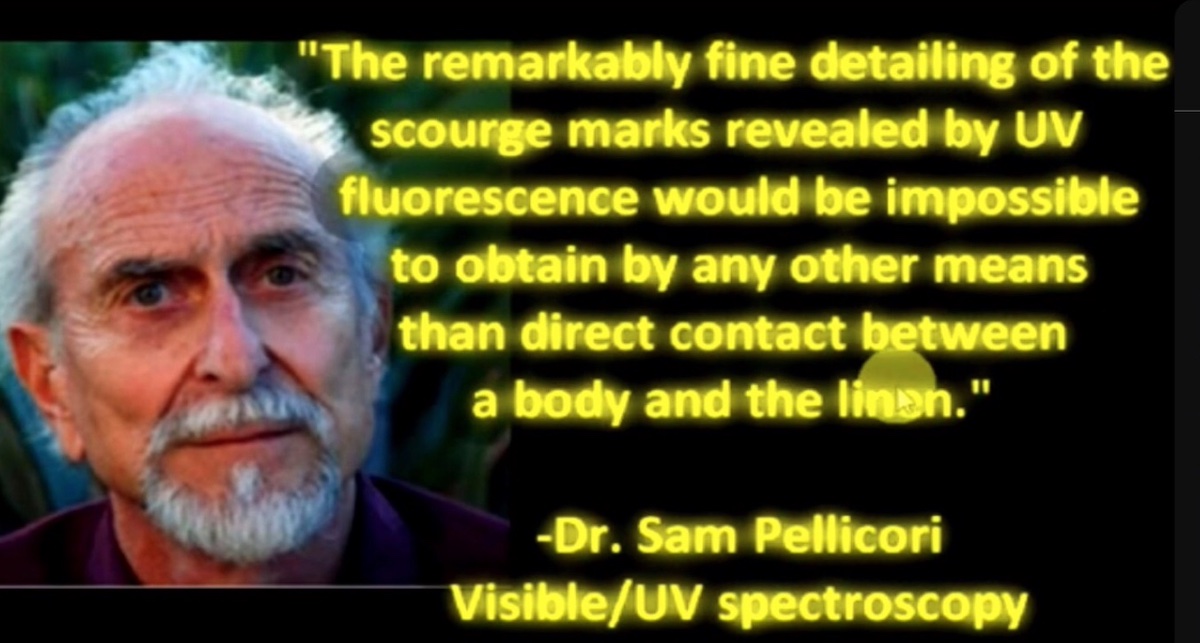
Sam Pellicori, who was a member of the STURP team and is still actively engaged in Shroud research, collaborates with Dr.Kearse. He also still publishes peer reviewed papers in the International Journal of Archaeology. He once stated that, “The remarkably fine detailing of the scourge marks revealed by UV fluorescence would be impossible to obtain by any other means than direct contact between a body and the linen.”
The evidence certainly points to a body being in the cloth. So does this disclude those who would produce as evidence the D’Arcis memorandum and the more recent letter of Nicolas Oresme? It seems that the most up to date hypothesis from the medieval brigade is that the image is actually an accident. That at one time it was a painting, or more precisely a cloth draped over a bas relief with red ochre being applied to create the image; that later the cloth would have been either washed or the ochre just fell off with the passing of time, leaving the faded image; that the blood however remained and a substance (like lemon juice) was applied to blood outlines to create ‘serum halos’ (the artist presumably realising that after nearly 700 years had passed, technology would be available that could allow us to see the effect).
There are many other academics who agree that the Shroud once held a body. A recent paper by Atle Ottesen Sovik entitled ‘The Shroud of Turin, a critical assessment’ (Atle Ottesen Søvik) looks at the likelihood that this was the case: “… it is most likely that the image derived from a dead crucified man […] I will now continue with the line of reasoning meant to show that the image comes from a dead man. The first point was that there is blood on the Shroud; the second point is that the blood was on the Shroud before the image was formed. This is a very important point, since if the Shroud is real one would expect that the blood came first, and then the image was created. But if it was artificially made, you cannot find any hypotheses on how you can make blood stains first, and then make the image around them”.
Of course this deduction was discovered by Dr’s Heller and Adler. It is disputed by sceptics as most pertinent data usually is. From all that we know it would seem that a body of a scourged, crucified man with a crown of thorns was once in the cloth. Was it Jesus or some unknown man? We’ll leave it for you and common sense to decide.

